

What Is Sustainable Coffee Explained for Daily Drinkers
Most people reach for a bag labeled “organic” or “fair trade” and feel they have done their part. That assumption is where the real story of what is sustainable coffee explained starts to get interesting. Genuine sustainability in coffee covers the full lifecycle from seed to cup, balancing three interconnected pillars: environmental responsibility, social equity, and economic viability. One label rarely captures all three. Understanding the full picture changes how you buy, brew, and think about the cup in your hands every morning.
Table of Contents
- Key Takeaways
- What sustainable coffee really means
- Decoding sustainable coffee certifications
- Impact on communities and ecosystems
- Sustainability beyond the farm: roasting and packaging
- How to identify and support sustainable coffee
- My honest take on where sustainable coffee stands
- Start your sustainable coffee practice with Uncharted
- FAQ
Key Takeaways
| Point | Details |
|---|---|
| Three-pillar framework | Sustainable coffee balances environmental health, social equity, and economic viability across the entire supply chain. |
| Certifications have limits | Organic, Fair Trade, and Rainforest Alliance labels signal progress but do not guarantee full supply chain sustainability. |
| Roasting practices matter | Energy source and waste management during roasting significantly shape a coffee’s total environmental footprint. |
| Traceability beats labels | Transparency about farmer names, prices paid, and sourcing relationships tells more than any single certification. |
| Consumers hold real power | Buying from brands that publish sourcing details directly funds better farming practices and community development. |
What sustainable coffee really means
Sustainable coffee is produced through farming and supply chain systems designed to be environmentally responsible, socially equitable, and economically viable for the long term. It is not a single certification or one farming technique. It is a systems-level commitment that has to hold up at every stage, from the soil where cherries grow to the hands that package your beans.
The three pillars work together, and neglecting any one of them eventually collapses the others.
Environmental pillar. This includes shade-grown cultivation that preserves tree canopy, crop rotation to rebuild soil health, water conservation during processing, and avoiding synthetic pesticides and fertilizers that degrade surrounding ecosystems. The Rainforest Alliance describes this integrated “people and nature” approach as the foundation for creating better global farming systems.
Social pillar. Sustainable farms pay fair wages, maintain safe working conditions, and prohibit child and forced labor. This is not just an ethical position. Worker stability directly correlates with crop quality and farm longevity. Farms with high turnover and poor conditions rarely produce consistent, high-quality harvests over time.
Economic pillar. Farmers need viable livelihoods to invest in sustainable practices. Direct trade relationships, financial transparency, and price floors all protect producers from the brutal volatility of commodity coffee markets. Without economic security, even the most environmentally motivated farmer cannot afford to farm sustainably.
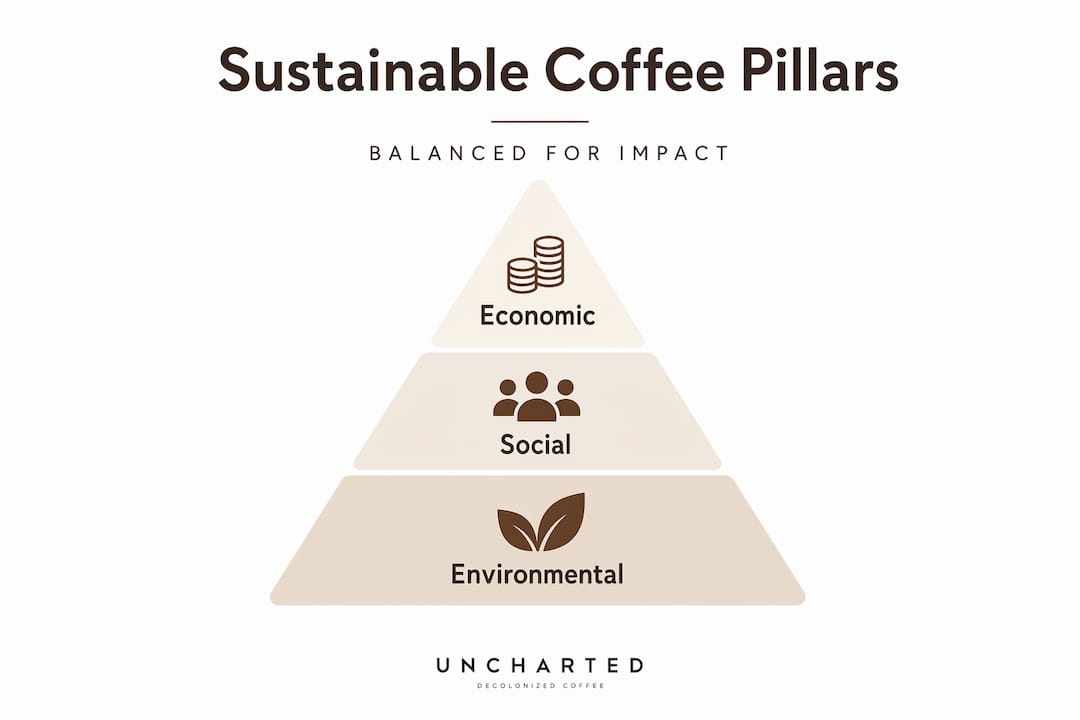
Pro Tip: When a brand talks about sustainability, ask which of these three pillars they address specifically. A brand strong on environment but silent on farmer wages is telling you something important.
Decoding sustainable coffee certifications
Understanding what certifications actually cover, and where they fall short, is one of the most useful skills any conscious coffee buyer can develop. Here is a breakdown of the three most common labels.
| Certification | Primary Focus | Key Requirements | Notable Gaps |
|---|---|---|---|
| USDA Organic | Environmental/chemical use | No synthetic pesticides, annual inspections, USDA-accredited agent oversight | Does not address wages or labor conditions |
| Fair Trade | Economic/social | Price floors, labor standards, community premiums | Environmental practices vary by producer |
| Rainforest Alliance | Environmental + social | Biodiversity, worker welfare, farm management plans | Allows some non-organic inputs under certain conditions |
| Bird Friendly | Habitat/biodiversity | Shade-grown, USDA Organic required, canopy coverage minimums | Narrower adoption, limited to specific origins |
USDA Organic certification requires formal authorization, annual renewal, and on-site inspections. Any operation selling more than $5,000 in organic products annually must be certified by a USDA-accredited agent, and maintaining certification demands continuous documentation updates. It prohibits most synthetic pesticides but does allow some natural substances under controlled conditions. What it does not cover is how workers are treated or what farmers are paid.
Fair Trade certification addresses the economic gap. It sets minimum price floors that protect farmers when global coffee prices drop below production costs, and it directs community development premiums toward education, healthcare, and infrastructure. The tradeoff is that Fair Trade’s environmental requirements are less stringent than dedicated environmental certifications.
The Rainforest Alliance attempts to bridge environmental and social criteria in one program. Diverse certifications like Fair Trade, Rainforest Alliance, and Bird Friendly focus on different pillars: farmer compensation, environmental protection, labor standards, and habitat conservation. No single certification covers every dimension equally well.
There is also a growing skepticism about whether certifications alone prove sustainability. Compliance benefits often concentrate where costs are lowest, leaving significant gaps in regions with smallholder or unorganized farmers. Ethiopia, one of the world’s most important coffee origins, faces real documentation and compliance challenges that certified labels rarely reflect.
Pro Tip: Think of certifications as a floor, not a ceiling. A certified coffee meets minimum standards. A truly transparent brand tells you what happens well above that floor.
To go deeper on how organic certification parallels across food categories, the process behind organic olive oil certification offers a useful comparison for understanding what annual inspections and documentation actually involve.
Impact on communities and ecosystems
The argument for sustainable coffee production is not abstract. It shows up in measurable outcomes for the people who grow it and the land it grows on.
Sustainable farming supports better livelihoods, reduces poverty, improves community infrastructure, and protects ecosystems by conserving forest cover and soil health. Fair Trade premiums have funded clean water systems, schools, and clinics in farming communities across Central America, East Africa, and Southeast Asia. These are not marketing claims. They are audited disbursements tracked at the cooperative level.
On the environmental side, the benefits include:
- Shade-grown coffee farms act as functioning carbon sinks, sequestering carbon while providing habitat for migratory birds and native pollinators.
- Agroforestry systems, where coffee grows beneath a canopy of native trees, preserve biodiversity at levels comparable to natural forest ecosystems.
- Reduced synthetic input use protects watershed health, which matters enormously in regions where farming communities also depend on those water sources for drinking.
- Soil health practices like composting and cover cropping build long-term fertility instead of depleting it.
Regulatory pressure is also reshaping how the industry operates. Costa Rica prepared for the EU Deforestation Regulation (EUDR) by georeferencing farms and certifying 800,000 units as deforestation-free, including a pioneering shipment of 19 metric tons to Italy in 2024. The EUDR requires that coffee sold in Europe cannot have contributed to deforestation after 2020. That kind of regulatory clarity, when paired with real traceability infrastructure, raises the floor for the entire industry.
The challenge is that smaller or less organized growing regions cannot always absorb the compliance costs. The gap between countries with strong traceability infrastructure and those without is widening, which is a problem the certification world has not fully solved.
Sustainability beyond the farm: roasting and packaging
Most conversations about sustainable coffee stop at the farm gate. That misses a significant portion of the environmental picture.
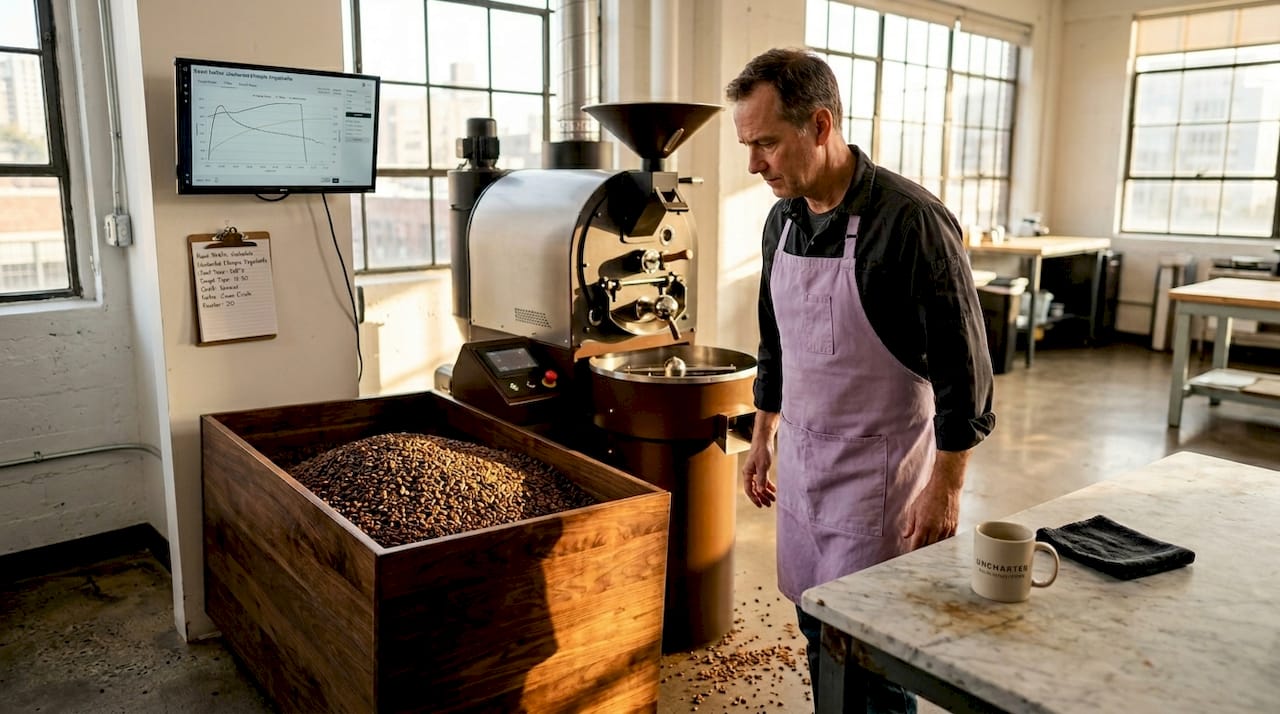
The full value chain including roasting energy sources, chaff waste handling, and packaging choices significantly influences a coffee’s carbon footprint. A bean grown with every sustainable practice available can still generate avoidable emissions if it is roasted using inefficient equipment or packaged in non-recyclable materials.
Energy source in roasting is one of the highest-impact variables a roastery controls. Ventless electric roasting reduces CO2 emissions by 87% compared to gas roasting. As electrical grids decarbonize through renewable energy, that advantage compounds over time. Electric roasters also eliminate direct combustion emissions entirely, which matters for air quality in urban roasting facilities.
Other operational factors that shape a roastery’s sustainability profile:
- Chaff management: coffee chaff, the dried skin removed during roasting, can be composted or repurposed as garden mulch rather than sent to landfill.
- Packaging: compostable bags, recyclable tins, and minimal-plastic designs reduce end-of-life waste without sacrificing freshness.
- Facility efficiency: LED lighting, smart HVAC systems, and water-efficient cleaning processes add up to meaningful reductions in operational footprint.
- Operational improvements like switching to electric roasters and optimizing waste management greatly enhance overall coffee sustainability beyond farming alone.
Pro Tip: Ask your roaster what energy source they use and how they handle chaff. A two-question test separates brands with genuine operational commitments from those whose sustainability story ends at the origin story.
One caution worth naming here: the term “regenerative” in coffee currently has no federal definition in the United States. Regenerative claims are often diluted because of this gap. When you see it on packaging, look for specifics: soil health metrics, cover crop programs, or third-party verification. Absent those details, the word is aspirational at best.
How to identify and support sustainable coffee
Reading labels well is a learnable skill. Here is a practical sequence for evaluating any coffee you are considering.
- Check for layered certifications. A bag with both USDA Organic and Fair Trade covers more ground than either alone. Bird Friendly plus Organic is among the strongest environmental combinations available.
- Look for named origins. A specific farm, cooperative, or region signals traceability. Generic “single origin” claims without a named source are a yellow flag.
- Find sourcing relationship details. Meaningful transparency includes farmer or cooperative names, prices paid, and the length of sourcing relationships. Vague sustainability claims without measurable details should prompt skepticism.
- Consider the roaster’s energy practices. This information is rarely on the bag but is often on the brand’s website. A few minutes of research reveals a lot.
- Support direct trade and cooperative models. These structures typically return more economic value to farmers than commodity-chain purchasing, even when certifications are not in place.
You can also explore the distinction between processing methods and how they relate to origin transparency by reading about natural process coffee and why those distinctions matter to sourcing integrity. For a broader context on quality benchmarks alongside sustainability, specialty coffee standards offer a useful lens.
My honest take on where sustainable coffee stands
I have spent years working around coffee supply chains, and the thing I keep coming back to is this: the industry uses “sustainable” as though it is a destination rather than a direction.
In my experience, the most genuinely sustainable coffees I have encountered come from brands that do not rely on certifications to make their case. They publish prices paid, name their farmers, and talk openly about what they are still working to improve. That kind of honesty is harder to fake than a label.
What I have learned is that certifications are necessary but not sufficient. They create accountability floors. But the gap between the floor and genuinely regenerative practice is wide, and most brands live somewhere in that middle ground without acknowledging it. Consumers who push brands to be specific, and who reward transparency over marketing, are the force that moves the needle.
The EUDR is the most interesting regulatory development I have seen in years. It is imperfect and unevenly applied, but it introduces the concept of verified traceability at scale. That matters more than any single label, because it creates consequences for getting the sourcing story wrong.
My take: do not let perfect be the enemy of genuinely better. Buy from brands that publish their sourcing relationships, ask hard questions when something seems vague, and treat your daily cup as the small, deliberate act it actually is.
— Jasmine
Start your sustainable coffee practice with Uncharted

Uncharted Coffee was built around exactly the kind of thinking this article describes. The brand’s mission centers on regenerative sourcing, fair labor practices, and treating coffee as a ritual that should leave the world better than it found it.
A good place to start is Revive Cold Brew, grown regeneratively in Costa Rica’s highlands. It is the kind of product that puts names, places, and practices behind every claim on the label. From there, the core collection spans single origins and blends sourced with the same transparency standards. And if you want to extend your values into everyday carry, the organic cotton tote is a small, consistent signal about how you move through the world.
Every cup is a choice. Uncharted Coffee makes it easier to choose well.
FAQ
What does sustainable coffee mean?
Sustainable coffee refers to coffee produced through systems that are environmentally responsible, socially equitable, and economically viable for farmers across the full supply chain, from seed to cup.
How is coffee considered sustainable?
Coffee becomes sustainable through practices like shade-grown farming, fair wage guarantees, chemical input reduction, and supply chain transparency that together protect people, ecosystems, and long-term farm viability.
What are the main sustainable coffee certifications?
The most common certifications are USDA Organic, Fair Trade, Rainforest Alliance, and Bird Friendly. Each focuses on different pillars: chemical use, farmer compensation, biodiversity, and habitat conservation, respectively.
Is organic coffee the same as sustainable coffee?
No. USDA Organic certification covers chemical inputs and annual farm inspections but does not address labor conditions or farmer wages. Full sustainability requires environmental, social, and economic accountability together.
Why does the roasting process affect sustainability?
Roasting energy source and waste management significantly shape a coffee’s carbon footprint. Ventless electric roasting reduces CO2 emissions by 87% compared to gas, making the roastery’s energy choices nearly as important as the farm’s practices.