

How a Coffee Cherry Becomes a Bean: Full Guide
Most people treat coffee like a liquid they consume, not a fruit they never see. But every cup you drink started as a small, bright red cherry growing on a flowering shrub somewhere between the tropics. Understanding how coffee cherry becomes bean is not just botanical trivia. It changes how you taste coffee, how you choose it, and what that morning ritual actually means. This guide walks you through every stage, from the moment a cherry ripens on the branch to the green bean ready for roasting, covering coffee cherry processing methods, anatomy, and the flavor decisions made long before the bag reaches your hands.
Table of Contents
- Key takeaways
- How a coffee cherry becomes a bean: growth and harvest
- Anatomy of the coffee cherry
- Coffee cherry processing methods and their effects
- Post-processing: drying, hulling, and sorting
- Flavor and what processing really controls
- My honest take on what this process reveals
- Taste the difference processing makes
- FAQ
Key takeaways
| Point | Details |
|---|---|
| Coffee “beans” are seeds | Each coffee cherry holds two seeds pressed face-to-face, not beans in any botanical sense. |
| Harvest timing shapes quality | Selective hand-picking of fully ripe cherries produces far superior flavor than strip picking. |
| Processing is a flavor dial | Washed, natural, and honey methods each produce distinct cup profiles from the same raw cherry. |
| Moisture control is critical | Beans must reach 10 to 12% moisture during drying to stay stable and mold-free before export. |
| Processing adds significant value | Green coffee imported at around $5 per kilogram can be worth over $26 per kilogram after roasting. |
How a coffee cherry becomes a bean: growth and harvest
Before any processing begins, the cherry has to exist. Coffee plants take three to four years after planting to flower, with the first real harvest coming around year five. From flower to ripe cherry takes another seven to nine months for Arabica varieties, and up to eleven months for Robusta. That is a long time to grow what most people consider a “morning beverage.”
Harvest timing and method vary widely by region. Most countries complete one main harvest per year. Colombia harvests twice annually due to its unique geography, which allows different growing zones to ripen at staggered times. Brazil, the world’s largest producer, relies heavily on mechanized strip picking because of its flat terrain and massive volume. By contrast, steep mountain farms in Ethiopia or Guatemala depend entirely on hand labor.
The two primary harvesting approaches are:
- Selective hand-picking: Workers pass through the farm multiple times, choosing only cherries at peak ripeness. Labor intensive, but it produces the most consistent quality.
- Strip picking: All cherries on a branch are removed at once, regardless of ripeness. Faster and cheaper, but the mix of under-ripe, ripe, and overripe cherries creates uneven flavor in the final cup.
Pro Tip: If a coffee label says “hand-picked” or “selective harvest,” that detail is not marketing language. It signals that someone made a deliberate choice about quality before the cherry ever left the farm.
Ripeness at harvest is one of the most consequential decisions in the entire coffee production chain. An underripe cherry carries starches not yet converted to sugars, producing grassy, hollow flavors even after expert roasting. No amount of skilled processing or roasting can recover what was never there to begin with.
Anatomy of the coffee cherry
Peel back the layers of a ripe coffee cherry and you find a surprisingly complex structure. Each layer plays a specific role in protecting the seed and, as it turns out, influencing the flavor of the bean inside.
| Layer | Botanical name | Role in processing |
|---|---|---|
| Outer skin | Exocarp | Removed in wet processing; dried intact in natural process |
| Pulp | Mesocarp | Edible, sweet fruit flesh; removed mechanically in wet and honey methods |
| Mucilage | Mucilage layer | Sticky, sugar-rich coating; its presence or absence is the defining variable in honey and washed coffees |
| Parchment | Endocarp | Protective papery shell around the seed; removed during hulling before export |
| Silver skin | Spermoderm | Thin membrane that mostly burns off during roasting |
| Seed | Coffee bean | The product everything else protects |
Most cherries contain two seeds pressed face-to-face, which is why standard coffee beans have one flat side and one curved side. The flat faces are where the two seeds made contact inside the cherry.
Occasionally, only one seed develops inside the cherry. This produces what is called a peaberry, a fully rounded bean with no flat face. Peaberry beans make up roughly 5 to 10% of any harvest. They are often sorted and sold separately because their uniform shape allows for more even heat distribution during roasting.
The mucilage layer deserves special attention. Ripe coffee cherries carry mucilage with 15 to 22 Brix of dissolved sugars, a concentration comparable to wine grapes at harvest. Those sugars are not just sweetness. They are fuel for the microbial fermentation that transforms raw seeds into complex, aromatic green beans.
Pro Tip: When tasting coffees from the same farm processed differently, pay attention to body and sweetness. Those qualities are largely determined by how much mucilage was left on the seed during drying.
Coffee cherry processing methods and their effects
This is where the from cherry to bean transformation gets genuinely fascinating. The processing method is the single biggest flavor decision made at origin, more impactful than most people realize when they buy a bag.
Here are the three primary methods, in order of how much fruit contact the seed experiences:
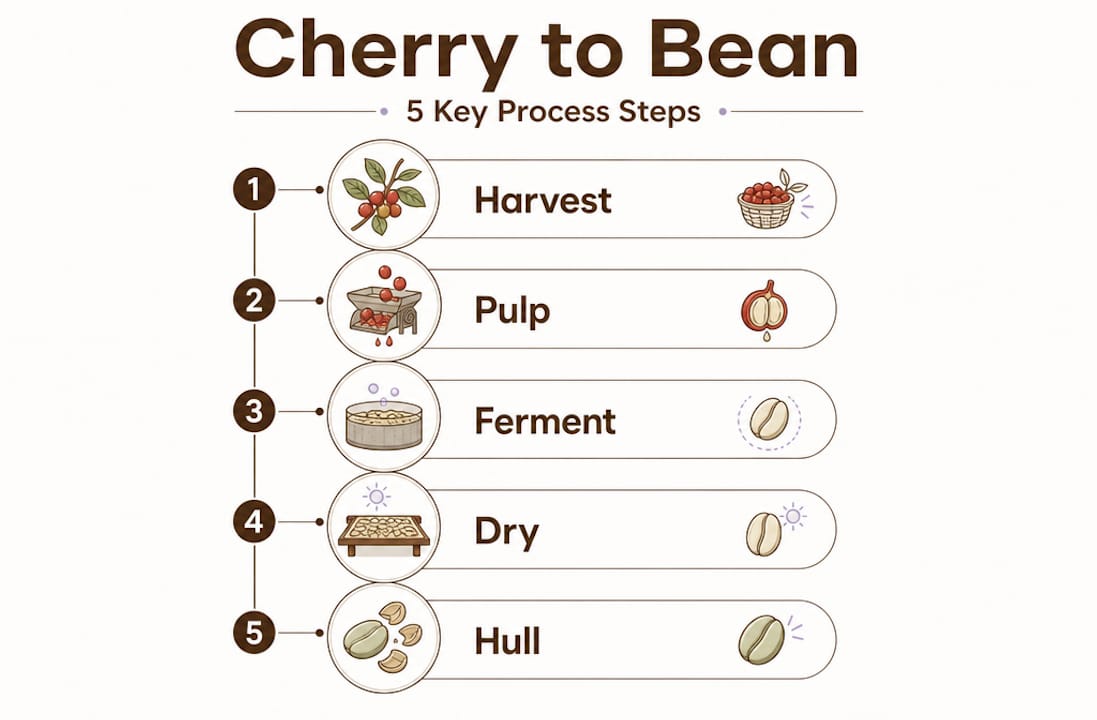
- Dry (natural) process: The whole cherry, skin and all, is spread on raised drying beds and left to dry in the sun for two to four weeks. The seed ferments slowly inside the intact fruit as sugars break down. This method is traditional, water-conservative, and produces the most fruit-forward, wine-like cup profiles.
- Wet (washed) process: The skin and pulp are removed mechanically within hours of harvest. The seeds, still coated in mucilage, soak in fermentation tanks for 12 to 72 hours to break down the remaining layer. Then they are washed clean and dried. The result is a brighter, cleaner cup that expresses terroir and variety with more clarity.
- Honey process: A middle path. The skin is removed but the mucilage is intentionally left on in varying amounts before drying. The spectrum runs from white honey (very little mucilage) to black honey (nearly full mucilage coverage), each producing a different level of sweetness and body.
Two methods worth knowing beyond these three:
- Giling Basah (wet-hulled): Specific to Indonesia, this process removes the parchment while the bean is still at high moisture content, around 30 to 35%. The result is earthy, low-acidity flavors and a distinctively heavy body that defines coffees from Sumatra and Sulawesi.
- Co-fermentation: A newer technique where additional fruits, juices, or microbes are introduced during fermentation to create specific flavor compounds. Innovative, yes. But experts have raised transparency concerns around whether these flavors accurately represent the coffee’s origin or simply mask it.
“Processing is not a binary choice between washed and natural. It’s a graduated dial, and each position on that dial produces something distinct.”
The environmental footprint of each method also matters. The wet process demands large amounts of clean water, which creates real constraints in water-scarce growing regions. The dry process requires almost no water but needs consistent sun and careful monitoring to prevent mold and uneven fermentation.
Post-processing: drying, hulling, and sorting
Once the processing method is complete, the work is not done. Green coffee still needs to reach a stable state before it can travel thousands of miles without deteriorating.
The target moisture content is around 10 to 12%. Too wet and the beans risk mildew during shipping. Too dry and they become brittle, leading to cracking during roasting.
Sun drying on raised beds remains the preferred method for specialty coffee. Elevated airflow on all sides allows for more even drying and allows workers to turn the beans regularly for consistency. Mechanical drying in large drum or bed dryers works faster and is less dependent on weather, but it requires energy and careful temperature control to avoid damaging the bean’s delicate flavor compounds.
| Drying method | Pros | Cons |
|---|---|---|
| Sun drying (raised beds) | Even drying, low energy cost, enhances flavor development | Weather dependent, slower, requires turning by hand |
| Mechanical drying | Consistent, weather-independent, faster | Energy intensive, risk of heat damage if temperature is not controlled |
After drying, the beans go through dry milling. This step removes the parchment layer (in washed and honey coffees) or the dried cherry husk (in natural coffees) using mechanical hullers. The exposed green beans are then sorted by size, weight, and density using screens, air jets, and gravity tables. Any defective beans, stones, or foreign material are removed, often with a final pass of hand sorting at origin.
The economic shift at this stage is significant. Green coffee imported at $5 per kilogram can be worth over $26 per kilogram once roasted. That value is built through every decision made from cherry selection through careful drying and hulling.
Pro Tip: Grading matters more than most consumers realize. Specialty grade coffees must score 80 or above on a 100-point scale, with virtually zero primary defects. The sorting stage is what makes or breaks that grade.
Flavor and what processing really controls
Once you understand the anatomy and the processing steps, the flavor logic starts to make sense. The mucilage is where most of the action happens.
During fermentation, the sugars in the mucilage interact with naturally occurring yeasts and bacteria. Those microbes produce acids, esters, and alcohols that penetrate the parchment and alter the flavor compounds forming in the seed. The 15 to 22 Brix sugar concentration in ripe cherry mucilage is high enough to drive meaningful fermentation, which is why natural process coffees from well-managed farms can taste like blueberries or red wine without any additives.
Key flavor implications by processing method:
- Natural process: Fruit-forward, heavier body, wine or berry notes, sometimes wild or complex fermentation character
- Washed process: Bright acidity, clean cup, more direct expression of the variety and growing region
- Honey process: Balanced sweetness, medium body, the characteristics shifting depending on how much mucilage was retained
- Wet-hulled: Heavy body, earthy, low acidity, often with cedar or tobacco notes
The co-fermentation debate is worth addressing honestly. Adding external flavor agents during processing can produce extraordinary results, but it raises a real question: are you tasting the coffee or the additive? The specialty coffee community continues to debate where the line sits between innovation and misrepresentation. The most trustworthy producers are transparent about what they add and why.
For anyone exploring natural process coffees for the first time, the difference in cup character compared to a washed coffee from the same country is striking. Processing is not a background detail. It is a primary ingredient.
My honest take on what this process reveals
What I’ve come to believe, after spending a lot of time tasting coffees processed every possible way, is that most people dramatically underestimate how much happened before the roaster ever touched the bean.
I’ve tasted two coffees from the same farm, same harvest, same variety. One was washed. One was natural. They tasted like they came from different countries. Not slightly different. Genuinely different cups. That experience shifted how I think about the word “origin.” Origin is not just geography. It is geography plus harvest timing plus processing method plus drying conditions. All of it.
What bothers me about how coffee is marketed is the way processing gets flattened into a descriptor on the back of the bag, a single word sitting under “notes” and “altitude” like a footnote. It is not a footnote. The choice to leave mucilage on or wash it off is one of the most consequential flavor decisions in the entire supply chain.
My advice to anyone serious about understanding their cup: order the same coffee from the same producer in two different processing styles. Drink them side by side. That single experience will teach you more about how coffee is made than any amount of reading.
Understanding this journey should also shape where you put your money. Producers who invest in careful selective harvesting, thoughtful processing, and proper drying are doing harder, slower work. That work deserves recognition, not just as a purchasing decision, but as part of what intentional coffee sourcing actually means.
— Jasmine
Taste the difference processing makes

Uncharted Coffee was built around the belief that a cup of coffee carries everything that happened before it reached your hands. The farm. The harvest decision. The fermentation time. The hands that turned the drying beans. That is why Uncharted sources from producers who treat processing as craft, not just a step in the supply chain.
The Revive Cold Brew, grown regeneratively in Costa Rica’s highlands, is a direct expression of what careful cherry selection and processing look like in the cup. For readers who want to explore how different origins and methods translate to taste, the Core Collection offers a range of profiles that make the cherry-to-bean journey tangible, not theoretical. Every bag tells you where it came from and how it was processed, because those details are not decoration. They are the point.
FAQ
What is a coffee cherry?
A coffee cherry is the fruit of the coffee plant, containing two seeds that become the coffee beans we roast and brew. The cherry passes through several layers including skin, pulp, mucilage, and parchment before the seed is exposed.
How long does it take for a coffee cherry to ripen?
Arabica cherries take seven to nine months to ripen after flowering, while Robusta cherries can take up to eleven months. Coffee plants typically begin producing their first harvest around five years after planting.
What does coffee cherry processing mean?
Coffee cherry processing refers to the method used to remove the fruit layers surrounding the seed and prepare it for export as green coffee. The three main methods are natural (dry), washed (wet), and honey, each producing distinct flavor profiles.
What is a peaberry in coffee?
A peaberry forms when only one seed develops inside a cherry instead of two, producing a rounded bean rather than two flat-sided seeds. Peaberries make up roughly 5 to 10% of any harvest and are often sorted separately for their unique roasting characteristics.
Does processing method really affect flavor?
Yes, significantly. The amount of mucilage contact during fermentation and drying directly shapes the acids, esters, and aromatic compounds in the final bean. A natural process coffee and a washed coffee from the same farm can taste like entirely different origins.