

Bean Origin's Role in Espresso Flavor Explained
Most espresso conversations start and end with roast level or brewing technique. But the role of bean origin in espresso flavor runs deeper than either of those variables. Where a coffee is grown, at what altitude, in what soil, and how it is processed after harvest shapes the chemical foundation that every roaster and barista works with. Before any heat touches a green bean, the flavor potential is already written into its molecular structure. This guide unpacks exactly how geography, soil, altitude, and processing conspire to produce the cup you taste.
Table of Contents
- Key takeaways
- The science behind bean origin and espresso flavor
- How altitude, soil, and climate shape your espresso
- Processing methods and their impact on espresso expression
- Regional espresso profiles you should actually know
- Practical advice for reading origin and dialing your shots
- My honest take on learning through origin
- Explore origin-driven espresso with Uncharted Coffee
- FAQ
Key takeaways
| Point | Details |
|---|---|
| Origin sets chemical foundations | Compounds like chlorogenic acids and lipids vary by region and directly shape aroma, acidity, and body in the cup. |
| Altitude predicts flavor tendencies | Higher altitudes generally produce more acidity and complexity; lower altitudes lean toward body and sweetness. |
| Processing can outweigh region | In coffees like Ethiopian varieties, natural vs. washed processing creates more flavor variation than the growing region alone. |
| Start with washed single origins | Washed lots minimize processing noise, making them the clearest way to study how origin actually tastes. |
| Regional profiles guide selection | Knowing typical flavor tendencies from Brazil, Kenya, or Sumatra helps you choose beans and dial in extraction with purpose. |
The science behind bean origin and espresso flavor
The connection between geography and taste is not poetic. It is chemical. Studies using FTIR-ATR on Coffea arabica cultivated across different regions of Minas Gerais, Brazil, show measurable differences in sensory attributes directly linked to chemical markers including chlorogenic acids, trigonelline, lipids, and sugars. These compounds do not behave the same way from one region to another. They shift based on growing conditions, and those shifts show up in fragrance, acidity, and body when you pull a shot.
Chlorogenic acids, for example, break down during roasting into compounds that affect perceived bitterness and acidity. Beans from higher-stress environments tend to accumulate more of these acids. Trigonelline contributes to the roasty, slightly bitter backbone of espresso and also degrades during roasting to produce niacin. Lipids influence crema stability and mouthfeel. None of these are uniform across origins.
“Chemical markers tied to origin can explain why the same roast level tastes fundamentally different across regions.” — insight from Coffea arabica chemical profiling research
This is why two espressos roasted to the same profile can taste completely different when the beans come from different countries. The raw material dictates what the roaster has to work with. Understanding the impact of bean origin means recognizing that geography is not just a label on the bag. It is a preview of chemistry.
| Chemical compound | Origin-linked variation | Sensory effect in espresso |
|---|---|---|
| Chlorogenic acids | Higher in stressed, high-altitude beans | Perceived acidity and brightness |
| Trigonelline | Varies by soil and climate | Roasty depth, slight bitterness |
| Lipids | Influenced by bean density and altitude | Crema texture, mouthfeel, body |
| Sugars | Affected by maturation rate and climate | Sweetness, caramelization, finish |
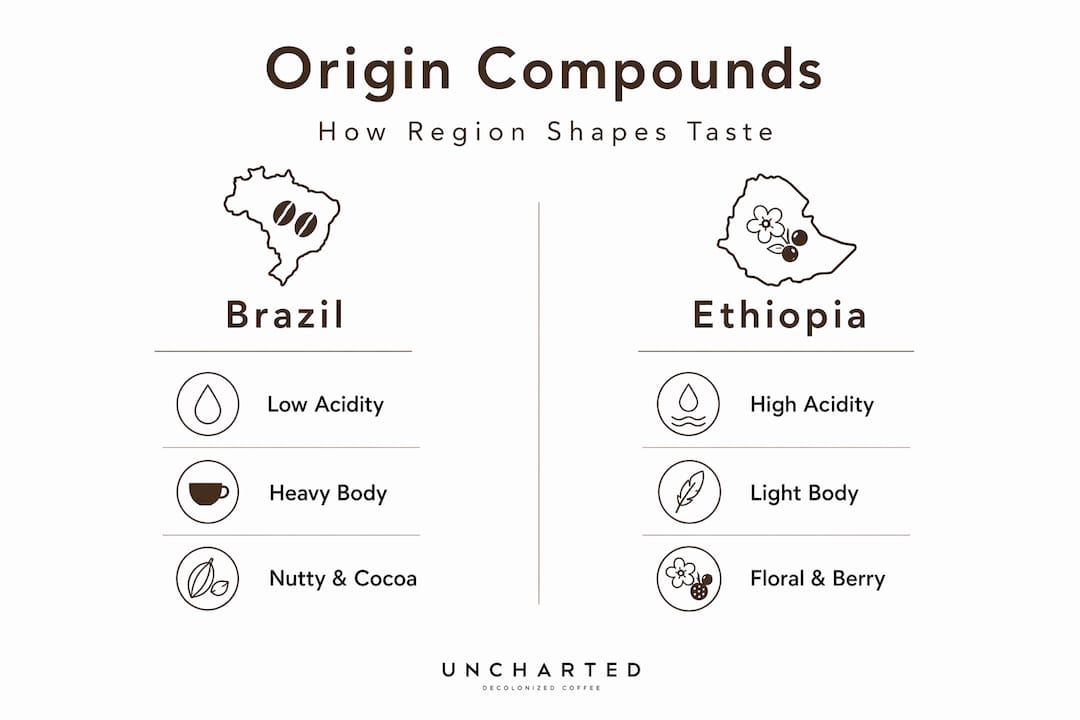
How altitude, soil, and climate shape your espresso
Geography is not a single variable. Altitude, soil type, and climate all work together, and each one pulls the espresso flavor profile in a distinct direction.
Altitude bands correlate clearly with flavor tendencies across growing regions. Beans grown at lower elevations, roughly 800 to 1,200 meters, tend to produce body-driven cups with softer acidity. Higher elevations, from 1,600 to 2,200 meters, deliver more pronounced acidity, denser beans, and greater aromatic complexity. The reason is simple: cooler temperatures at altitude slow the maturation of the coffee cherry. That slower maturation allows more time for complex sugars and lipids to develop inside the seed. The result is a denser, more intricate bean that extracts differently and produces a heavier, more viscous espresso body.
Soil composition adds another layer. Volcanic soils, found in regions like Guatemala, El Salvador, and parts of Ethiopia, are rich in minerals that some researchers associate with enhanced sweetness and clarity in the cup. The exact mechanism is still being studied, but baristas working with beans from volcanic terroirs consistently report a distinct brightness and clean finish that is hard to replicate with beans from non-volcanic origins.
Climate determines the consistency of maturation and the density of the harvest. Regions with clearly defined wet and dry seasons produce cherries that ripen more uniformly. That uniformity translates to more predictable extraction behavior and fewer surprises when you are dialing in your espresso.
- High altitude (1,600m+): Bright acidity, floral and fruity aromatics, higher density, more complex extraction
- Mid altitude (1,200 to 1,600m): Balanced acidity and body, reliable extraction, clean sweetness
- Lower altitude (800 to 1,200m): Heavy body, chocolate and nutty notes, softer acidity, forgiving extraction
- Volcanic soils: Enhanced mineral clarity, distinct sweetness, clean aftertaste
- Equatorial climates: Year-round harvests, varied lots, more diversity within a single origin
Pro Tip: Altitude-driven flavor tendencies are probabilistic, not guaranteed. Always assess each individual lot rather than assuming a high altitude label automatically means bright acidity. Terroir interacts with variety, processing, and harvest quality in ways that can override general altitude expectations.
Processing methods and their impact on espresso expression
Here is where the narrative around coffee bean origins gets genuinely complicated. Processing method has the potential to create more flavor variation than the growing region itself. That is not a minor footnote. It reframes how you should read every bag label.
The contrast between washed and natural processing is stark in the cup. Washed coffees undergo controlled fermentation for 12 to 36 hours, then dry to approximately 10 to 12% moisture. The result is a cleaner, brighter cup where origin character comes through without the influence of fruit fermentation. The coffee tastes like the place it was grown, not the method used to remove its skin.
Natural processing does the opposite. The coffee cherry dries whole, and the fruit’s sugars and microbes work on the seed over weeks. The cup becomes fruitier, heavier, more wine-like. The processing creates flavor, not just preserves it.
Ethiopia makes this vivid. In Ethiopian specialty coffees, the processing method drives more flavor variation than the growing region. A naturally processed Yirgacheffe and a washed Yirgacheffe from neighboring farms can taste like entirely different coffees:
- Natural Ethiopian espresso delivers heavy body, jammy texture, and intense fruit notes ranging from blueberry to dried cherry. The cup is bold and complex in a way that feels almost wine-like.
- Washed Ethiopian espresso is lighter, more tea-like, with floral aromatics and clean citrus brightness. It feels precise and transparent.
- Honey-processed Ethiopian sits between the two: some fruit sweetness, moderate body, and more clarity than naturals.
- Regional subvariation within washed lots produces subtler differences, with Guji showing more stone fruit than Sidama, for example. But those differences are far smaller than the processing-driven gap between washed and natural.
Pro Tip: When you are first learning to taste origin-driven flavors, stick to washed lots from the same country. Comparing a washed Yirgacheffe to a washed Guji teaches you genuine regional terroir differences without processing artifacts clouding your palate.
Regional espresso profiles you should actually know
Understanding how origin affects espresso becomes practical when you connect geography to flavor expectations. Here is how the major regions actually taste as espresso, and why.
| Origin | Typical body | Acidity | Key flavor notes | Best as |
|---|---|---|---|---|
| Brazil | Heavy, syrupy | Low | Chocolate, hazelnut, brown sugar | Blend base, single origin |
| Colombia | Medium to full | Balanced | Red fruit, caramel, clean finish | Single origin, milk drinks |
| Ethiopia | Light to medium | High | Floral, blueberry, citrus, jasmine | Single origin espresso |
| Kenya | Full | Bright, complex | Blackcurrant, tomato, citrus | Single origin, experienced palates |
| Sumatra | Very heavy | Low | Earthy, cedar, dark chocolate, tobacco | Blend base, strong milk drinks |
| Guatemala | Medium | Bright | Dark chocolate, stone fruit, spice | Single origin, balanced blends |
Brazilian natural-processed coffees are the backbone of most commercial espresso blends for good reason. Their heavy, syrupy body and chocolate-forward profile create the coating mouthfeel that works well with milk. Colombian washed coffees bring medium-to-full body with a clean, juicy texture that highlights sweetness. Kenyan coffees are a different experience entirely. The bright blackcurrant and tomato-like acidity surprises people the first time. It is not defective. It is terroir.
When building espresso blends, roasters typically use Brazilian or Indonesian beans for body and sweetness, then layer in Ethiopian or Colombian origins for acidity and complexity. Single-origin espressos demand more from both the barista and the drinker, but they reward attention with transparency you simply cannot get from blends.
Practical advice for reading origin and dialing your shots
Knowing the theory matters. Applying it at the grinder matters more.
Start your origin education with washed single-origin lots. Washed coffees minimize processing flavor noise, making them the clearest window into what terroir actually tastes like in the cup. A washed Colombian or Ethiopian gives you origin character without fermentation artifacts competing for your attention.
When reading a bag, look for four things: country, region or subregion, altitude, and processing method. A bag that says “Ethiopia, Yirgacheffe, 1,900m, washed” tells you to expect brightness, clarity, and floral aromatics. Adjust your grind finer if you want to extend that brightness. Pull a slightly shorter shot to preserve the delicate acidity without turning it sharp.
Natural processed coffees show more lot-to-lot variability than washed coffees. They reward exploration once your extraction skills are solid. If you pull naturals before you understand how to manage their heavier body and density, you will chase your tail adjusting variables that the bean itself is controlling.
Pro Tip: When switching between origins, reset your expectations entirely before resetting your grinder. An Ethiopian washed and a Brazilian natural may both be labeled as medium roast, but they will extract completely differently due to bean density and lipid content tied to their origin and processing.
My honest take on learning through origin
I spent my first two years obsessing over roast curves. It was a reasonable place to start, but it also created a blind spot I did not recognize until I started comparing washed Ethiopian lots side by side with naturals from the same farm. The difference was so dramatic that it reframed everything I thought I knew about dialing in espresso.
What I have learned is that baristas often underappreciate the textural influence of soil and altitude on extraction dynamics. Everyone chases flavor notes. Fewer people pay attention to how a Sumatran bean pulls through the puck differently than a Kenyan one, and how that resistance affects pressure, time, and body in the final cup.
The most common mistake I see is treating origin as a marketing detail rather than extraction data. When a bag says volcanic soil, high altitude, and washed processing, that is a technical profile, not a story. It tells you the bean is dense, acidic, and clean. It tells you to grind finer, watch your temperature, and expect a bright, quick extraction that rewards restraint.
Start with washed single origins. Compare within a country before comparing across countries. Give yourself at least a full bag to understand how an origin behaves before you judge it.
— Jasmine
Explore origin-driven espresso with Uncharted Coffee
If this guide has shifted how you think about what is in your cup, the next step is tasting it for yourself. Uncharted Coffee sources with origin transparency at the center, so every selection comes with the information you need to understand what you are drinking and why it tastes the way it does.

At Uncharted Coffee, you will find both washed and naturally processed single-origin options, each selected for traceability and flavor integrity. If you want to experience high-altitude, regeneratively grown origin character, the Revive Cold Brew from Costa Rica’s highlands is a clean example of how geography shapes a cup. For enthusiasts ready to explore the full range of what origin can do, the limited releases showcase high-specificity lots that make origin differences unmistakable.
FAQ
What is the role of bean origin in espresso flavor?
Bean origin determines the chemical profile of coffee, including chlorogenic acids, lipids, and sugars, which directly shape the acidity, body, aroma, and texture of espresso. Geography, altitude, and soil composition set the flavor potential before roasting or brewing begins.
Does altitude really change how espresso tastes?
Yes. Higher-altitude beans mature more slowly, developing greater sugar and lipid complexity, which produces more acidity and aromatic depth in espresso. Lower-altitude beans tend toward heavier body and softer acidity.
How does processing affect espresso flavor compared to origin?
Processing can create more flavor variation than region alone. In Ethiopian coffees, natural processing produces heavy, fruity, jammy espresso while washed processing yields a clean, floral, tea-like cup, even from beans grown on neighboring farms.
Which origin is best for learning to taste terroir in espresso?
Start with a washed single-origin coffee from Ethiopia or Colombia. Washed coffees reduce processing-driven flavor variation, making origin-driven characteristics much easier to identify and learn from.
Why do espresso blends typically combine multiple origins?
Roasters blend origins to balance body, acidity, and sweetness. Brazilian beans provide the heavy, syrupy base while Ethiopian or Colombian beans add brightness and complexity, creating a profile no single origin delivers on its own.